How to Grow Your Mobile App to 1 Million Users Without Ads

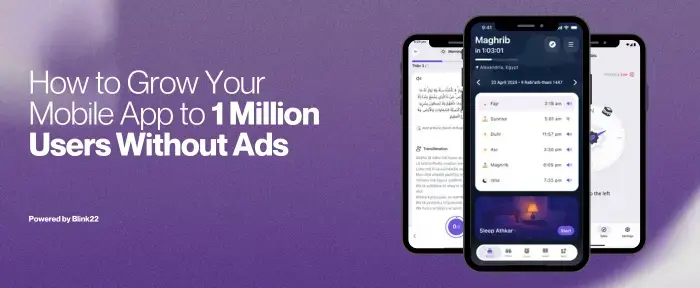
When we launched Fajr App, we made a decision that seemed counterintuitive in today's paid-acquisition-obsessed mobile ecosystem: we would grow organically, without spending a single dollar on ads.
Not because we couldn't afford ads. Not because we were against paid marketing. But because we believed that if we built something genuinely useful and focused on the right strategies, users would find us, and more importantly, they'd stay.
Today, with nearly 1 million downloads and a 4.9/5 App Store rating, we're sharing the exact rules we followed. Along the way, we'll bring in real-world examples from companies that have successfully scaled to millions of users the same way: by earning every single one.
Why Some Apps Grow Organically While Others Don't
Before diving into tactics, let's address the elephant in the room: not every app can grow organically.
The brutal truth about the mobile app ecosystem is this: only about 13% of business apps succeed, and even fewer consumer apps make it. With over 5 million apps on the App Store and Google Play competing for attention, the odds are inherently against you.
But here's what we discovered: apps that grow organically share certain specifications. They're not just good; they're built for organic growth from day one.
Pillars of Organic Growth Potential
Here are the five pillars we've identified from our own experience and from studying the best in the industry.
1. Build an App With a Real Purpose
"If you are not embarrassed by the first version of your product, you've launched too late." — Reid Hoffman, Co-founder of LinkedIn
The most powerful growth engine is a product that genuinely solves a real, recurring problem. Not a manufactured pain point. Not a marginal improvement on an existing tool. A problem people actively lose sleep over… sometimes literally!
Fajr Alarm was born from exactly that. Muslims worldwide struggle to wake up for Fajr prayer, the pre-dawn prayer that requires rising before sunrise. Traditional alarms fail because users can dismiss them while half-asleep.
The problem was crystal clear and deeply personal for millions of people who genuinely wanted to establish this vital spiritual habit but were losing the battle with sleep inertia every morning.
As the product matured, the purpose expanded naturally. Why stop at waking up for Fajr? Users also needed accurate prayer times, Qibla direction, a structured Athkar (daily supplications) collection, and during Ramadan, tools to track their prayers and complete Quran readings (Khatma).
What started as a smart alarm evolved into a complete Islamic lifestyle companion, not because we forced it, but because the community showed us the way.
As you can see, purpose-driven products don't need to beg for attention. Users who feel understood become advocates.
Other Examples:
Calm identified that millions of people wanted to sleep better and manage stress but found meditation intimidating. It solved that exact problem and grew to 100 million downloads largely through word-of-mouth and App Store features.
Notion solved the "scattered productivity tools" problem that millions of knowledge workers faced. Its purpose was so clear that users built entire communities around it before Notion ran a single ad.
Practical tips:
Write a one-sentence answer to: "What specific, recurring pain does my app eliminate?"
If you can't answer it clearly, neither can your potential users.
Validate the problem before building. Talk to 20 real people in your target audience. What words do they use to describe the pain? Use those exact words in your App Store copy.
Look for problems where existing solutions are "good enough but not great." That gap is where organic growth lives.
2. Create an Enjoyable, Delightful User Experience
"Design is not just what it looks like and feels like. Design is how it works." — Steve Jobs
Getting users to download your app is one challenge. Getting them to open it again tomorrow is another. Getting them to tell their friends about it is the holy grail. And all three depend on one thing: how the app makes them feel.
Delightful UX goes far beyond bug-free code. It means users actively enjoy using your app. They look forward to it. They feel satisfied after each interaction.
For Fajr App, we focused obsessively on solving real frustration points with elegant, thoughtful design.
The alarm doesn't just ring; it challenges you. Users must shake their phone, solve math problems, or complete memory games before they can dismiss the alarm. This gamification ensures they're truly awake, not just groggily tapping "snooze."
The app also plays the Adhan (call to prayer) even in Do Not Disturb mode because missing Fajr shouldn't happen due to a silenced phone. We built that technical capability specifically because it mattered to our users.
Other Examples:
Duolingo and Wordle are masters in how to keep users hooked through psychology and enjoyable user experience.
Duolingo doesn't just teach languages; it’s psychologically engineered to keep you coming back. It uses "Loss Aversion" through its Streak feature. Once you have a 50-day streak, the fear of losing that progress is more motivating than the actual lesson.
Combined with Leaderboards that spark friendly competition and XP systems that give you an instant dopamine hit, Duolingo has reached 500 million users. It has the kind of daily engagement that traditional language schools can only dream of.
Similarly, Wordle’s massive success—before its New York Times acquisition—was built on a single, brilliant user experience (UX) choice: the shareable emoji grid.
By allowing players to post their colored square results without giving away the answer, Wordle turned every player into a walking advertisement. It fueled a viral growth loop that required zero marketing spend.
Practical Tips:
Map your user's emotional journey through your app. Where do they feel confused? Frustrated? Rewarded?
Add at least one "moment of delight." Something unexpected and positive. This becomes what users talk about.
Reduce friction ruthlessly. Every extra tap between intent and action is a potential drop-off point. Research shows that a one-second delay in load time can reduce conversions by up to 20%.
Consider gamification elements: streaks, progress tracking, challenges, milestones. They work because they tap into fundamental human psychology.
Test your onboarding with real users. If they can't figure out your core value in the first 60 seconds, you'll lose them forever.
3. Master App Store Optimization (ASO)
"SEO is not something you do anymore. It's what happens when you do everything else right." — Chad Pollitt, Co-founder of Relevance
If organic growth had a foundation, it would be App Store Optimization. For mobile apps, ASO is the key to organic discoverability in the App Store and Google Play.
Think of ASO as SEO for app stores. Done right, it's a perpetual growth engine that works while you sleep. Yet most developers treat it as an afterthought… a title and a few screenshots slapped together before launch.
That's a massive missed opportunity. According to data released by Apple Search Ads, over 65% of app downloads come directly from App Store searches. If you're not optimizing for those searches, you're invisible to the majority of your potential audience.
ASO is not a one-time task. It's an ongoing discipline that includes:
Keyword Research and Optimization
Your app title, subtitle, and keyword fields are very important. Treat them like Google AdWords.
Research what your target users actually type when they need an app like yours. Not what you think they're searching for, but what they actually type into the app store search box.
Tools like AppFollow, Sensor Tower, and AppTweak help you find high-volume, low-competition keywords.
For Fajr Alarm, keywords like "Muslim prayer alarm," "Fajr wake up," "Islamic prayer times," and "salah reminder" were gold. We didn't guess. We researched what users were actually searching for and built our metadata around those terms.
Screenshots and Preview Videos That Convert
Your screenshots are your sales page inside the App Store. They should tell a story, highlight your key benefit in the first frame, and use real UI, not generic stock images. Apps with preview videos see up to 35% higher conversion rates.
The icon, screenshots, and preview video determine whether someone who finds your app actually downloads it.
Pro tip: Don't just show your app. Show the benefit.
Bad screenshot caption: "Beautiful interface"
Good screenshot caption: "Never miss Fajr prayer with creative wake-up alarms"
Ratings and Reviews as a Growth Loop
A 4.5+ rating is a trust signal that drives downloads. A 4.9+ rating (like Fajr App) is a competitive moat. Prompt happy users to leave reviews at the right moment. Respond to every review, positive or negative. It signals to potential users that a real team cares about their experience.
Practical Tips:
Update your ASO every quarter. Trends change. Keywords that worked six months ago might be less relevant today.
A/B test your icon. It's the first thing users see in search results. Small changes can produce dramatic differences in click-through rate.
Localize your App Store listing if you're targeting multiple markets. Even a basic translation of your description can dramatically improve conversion in non-English markets.
Monitor your competitors' ASO strategies without copying them blindly. Find the gaps they're missing.
4. Listen to Users and Build With Them, Not Just For Them
"Your most unhappy customers are your greatest source of learning." — Bill Gates
The apps that grow through word-of-mouth do so because users feel ownership. They feel heard. They see their feedback turn into features. That emotional investment transforms passive users into vocal advocates. They’re the most powerful marketing team you'll never have to pay.
This was one of the most transformative lessons we learned with Fajr Alarm. We didn't launch with a prayer tracker. We didn't launch with all the features now available on the app. Users told us they needed these things. We listened, built them thoughtfully, and each new feature deepened user engagement and triggered a new wave of word-of-mouth referrals.
During Ramadan, we added a prayer tracker and Quran Khatma feature based on user requests, allowing users to mark their progress reading the complete Quran with beautiful visualizations. We included the full Quran with multiple reciters and Tafsir (interpretations) for deeper understanding.
We also found that many users wanted an incentive to track group and masjid prayers, so we built a reward system to help build and sustain that habit. Every feature felt purposeful because it came directly from the community.
Other Examples:
Instagram’s origin story is a lesson in following the data. It actually began as Burbn, a complex check-in app. However, the founders noticed that users weren't interested in the check-ins. Rather, they were obsessed with the photo filters.
So instead of forcing their original vision, they stripped away the extra features and rebranded as a photo-sharing app. By responding rapidly to how people actually used the product, they turned a cluttered app into a global phenomenon.
Another example is Superhuman, the email client, which didn't leave its success to chance. They used a specific "Product-Market Fit Survey" to ask early users, "How would you feel if you could no longer use Superhuman?"
By focusing exclusively on the users who said they would be "very disappointed," they identified their "power users." This deep listening allowed them to double down on exactly what those people loved, like speed and keyboard shortcuts, shaping their entire pricing and marketing strategy around them.
Practical Tips:
Set up easy feedback mechanisms. Make it easy for users to tell you what's missing, not just what's broken. And don’t just apologize; solve!
Monitor your App Store reviews daily. Patterns in reviews are a product roadmap waiting to be read.
When you ship a feature that came from user feedback, tell them. Post about it. Tag those users if possible. This creates a powerful feedback loop where more people want to contribute ideas because they see that ideas get built.
Use tools like UserVoice or Canny to collect and prioritize feature requests transparently.
5. Don't Follow the Competition—Carve Your Own Path
"The most contrarian thing of all is not to oppose the crowd but to think for yourself." — Peter Thiel, Co-founder of PayPal
The most dangerous trap in product development is competitive mimicry. You look at what's working for a competitor, copy it, and wonder why it doesn't work as well for you.
The answer is simple! You're playing their game with their users. You'll always be second.
The apps that achieve extraordinary organic growth do so by zigging when everyone else zags.
When we built Fajr App, we didn't look at what other Islamic apps were doing and try to do it better. We asked a different question: what does this community actually need that no one is giving them?
The answer led us to gamified wake-up challenges (not just louder alarms), smart Adhan playback in DND mode, which is a technical problem no one had properly solved, and eventually a complete lifestyle companion rather than a single-purpose utility.
Other Examples:
Notion didn't build a better Evernote. It built a fundamentally different philosophy of personal organization, one where you could create your own tools rather than adapt to someone else's. That made it one of the fastest-growing productivity apps in history.
Spotify didn't just build a better music downloader when music piracy was rampant. It asked why people pirated music (instant access, discovery, no friction) and built a legal product that delivered the same emotional outcome. It won by understanding user motivation at a deeper level than competitors.
WhatsApp didn't reach 2 billion users by trying to out-shout giants like iMessage or traditional SMS providers. Instead, it won by quietly solving a massive pain point that they ignored: global fragmentation.
While Apple and cellular carriers built "walled gardens" that were expensive or difficult to use across different phone types and borders, WhatsApp focused on a frictionless, cross-platform experience.
It turned a phone number into a universal ID, allowing someone in Brazil to text someone in India for free, regardless of their device. By solving this specific, cross-border communication problem, they transformed a simple utility into a global necessity.
Practical Tips:
Do a weekly competitive audit, but use it to identify gaps, not features to copy.
Ask this question regularly: "What does our target user still complain about even after using the best app in our category?"
Invest in at least one differentiating feature or experience that no direct competitor offers. Own that space completely before expanding.
Talk to users who switched away from your competitors. Their frustrations are your opportunity.
Be willing to look strange to industry insiders if it means being exactly right for your users. The apps with the most distinctive, albeit counterintuitive, value propositions tend to win the word-of-mouth game.
The Compound Effect: How These Pillars Work Together
Here's what we discovered: these five pillars don't just add up; they multiply each other.
A clear purpose attracts the right users. A delightful experience makes them stay. ASO makes sure new users can find the app in the first place. Listening to users deepens their loyalty and generates new feature ideas. And charting your own unique path ensures you build something worth talking about.
When all five are firing simultaneously, you get what growth experts call a flywheel: each satisfied user brings in more users, which generates more feedback, which improves the product, which satisfies more users. Amazon has talked about this flywheel concept for years. It applies just as powerfully to mobile apps.
For Fajr Alarm, the flywheel looked like this:
A Muslim struggling to wake up for Fajr downloads the app
The gamified alarm actually works. They wake up, they pray
They tell their friends
Those friends download the app
Some of them leave reviews and suggest features
We build those features
The app gets better; ratings go up; ASO improves
More users find it in the App Store and Play Store
The cycle repeats
No ads required.
Where to Go From Here
Reaching 1 million users without ads isn't a shortcut. It's a longer road with a better destination. The users you earn organically are more loyal, more engaged, and more likely to become advocates. And the business you build on that foundation is far more resilient than one dependent on paid acquisition.
Here's your action plan:
Audit your purpose. Can you describe the specific pain your app solves in one sentence? If not, start there.
Map the UX journey. Find your friction points and your delight moments. Fix the former. Amplify the latter.
Run a full ASO audit. Are your keywords, screenshots, and description optimized for how users actually search?
Open a feedback channel. Create a direct line to your users and commit to actually using what you learn.
Find out what makes you unique. What's the one thing you can do that no competitor is doing, and not because they haven't thought of it, but because they don't believe it's worth doing?
The path to 1 million users without ads is open. It just requires building something people actually need, building it beautifully, and treating every user as a partner in making it better.
That's what Blink22 did with Fajr Alarm. And we're just getting started.