How to Grow Your App and Overcome the Retention Slump
Getting users to download your app is one thing.
Getting them to keep the app on their phone is a totally different thing.
If you put an effort into adjusting your store listing, you’ll see promising downloads and results right after launch. For a brief moment it’ll feel like you've cracked it. Then, somewhere around month two or three, the numbers plateau. For each download, you get an uninstall. Users aren't coming back. Engagement drops. Growth stalls.
If this sounds familiar, you're not alone, and you're not out of options, too. At Blink22, we've built and scaled in-house and client apps from the ground up, so we know firsthand that sustainable mobile app growth isn't about chasing downloads. It's about building something people genuinely can't put down.
Here's what's really going on and how to fix it.
Why Downloads Don't Matter (As Much As You Think)
Downloads are often the most visible metric in mobile app growth. They're easy to track, easy to celebrate, and easy to report. They're also one of the most misleading indicators of success. An app can generate thousands of downloads and still fail.
A user who opens your app once and never returns contributes to acquisition numbers but creates no long-term value.
What matters isn't how many people install your app. What matters is how many people keep it on their phones and continue using it.
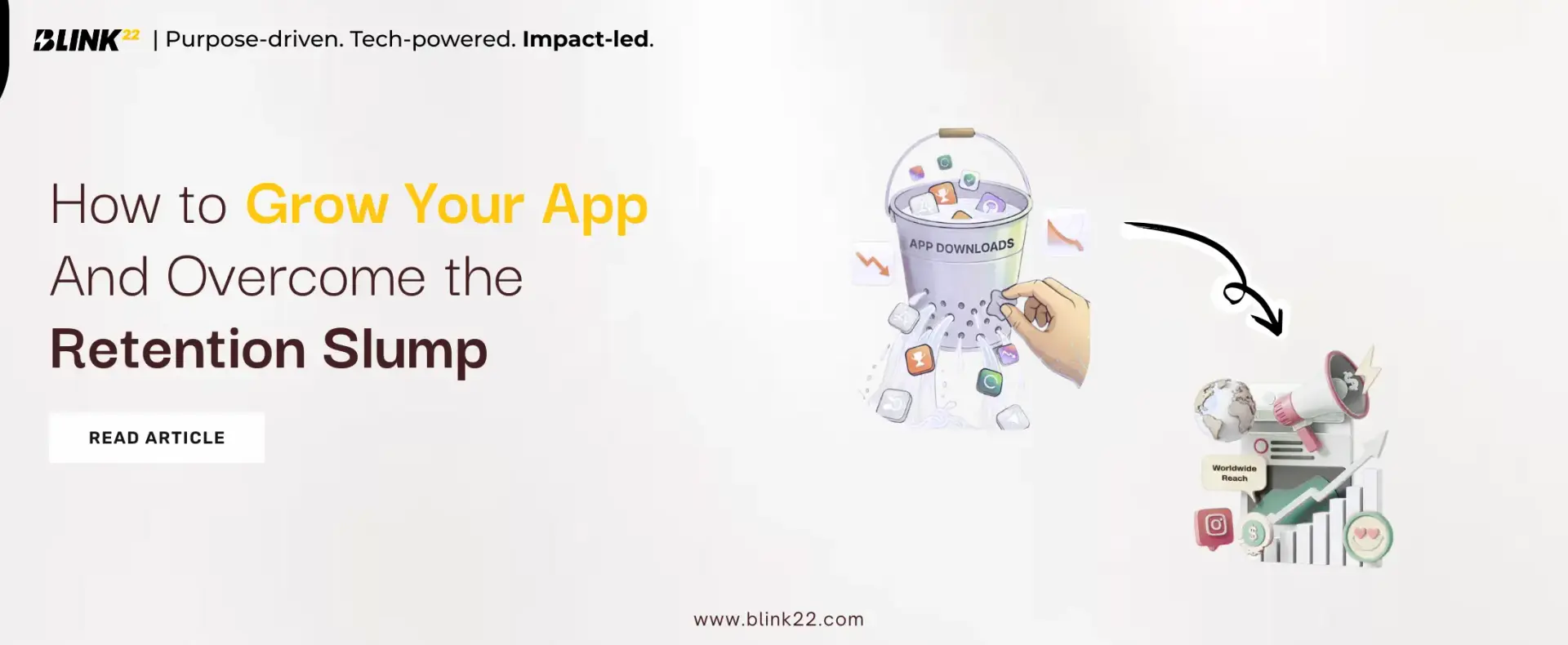
According to Statista, the average app loses more than 70% of its daily active users within the first 30 days after install. By day 90, that number climbs even higher. So if you're optimizing for downloads, you're essentially filling a bucket full of holes.
The Real App Growth Metrics
If you want to understand your app's true health, shift your attention to these:
Day 1 / Day 7 / Day 30 Retention Rates: The clearest signal of product-market fit. If users aren't returning after day one, something is broken at the core experience level.
Session Length and Frequency: Are users spending meaningful time in your app? Are they coming back daily or weekly? This tells you about habit formation.
Activation Rate: The percentage of new users who reach your app's core value for the first time. For a productivity app, that might mean completing a task. For a social platform, it could mean connecting with friends. For a fitness app, it may be logging the first workout. If this is low, your onboarding is the problem.
Churn Rate: How fast are you losing users? High churn will always outpace acquisition no matter how big your marketing budget is.
NPS (Net Promoter Score): Are your users telling their friends? Word of mouth remains one of the most powerful and cheapest app growth strategies available.
These are the numbers that tell the real story.
The Three Common Growth Killers
If your growth has stagnated, it usually comes down to one of three things. And we see these patterns repeatedly across the industry:
1. The "Empty Room" Effect
Your user opens the app for the first time and sees… nothing. No content, no features to hook them, no immediate reason to care.
Apps that rely on user-generated content or network effects are especially vulnerable here. If the value only appears after users contribute, you need to seed that value artificially until the flywheel spins. If you’re a utility app, you need to provide a sufficient onboarding experience to hook users and keep them engaged.
2. Feature Friction
You're solving the right user problem, but you've buried the solution behind too many taps, too many forms, or too much cognitive load.
The user knows what they want, but you're just making it exhausting to get there. Every unnecessary step between open and value is a place where you lose someone.
Audit your critical user journeys ruthlessly. If it takes more than three taps to reach your core feature, start cutting. Users should experience value within minutes, not hours.
3. The Wrong Crowd
One of the most costly mistakes in mobile app growth is attracting users who aren't a good fit.
If you're targeting the wrong audience, you can spend a lot of money on acquisition campaigns but still get low retention rates.
This creates a dangerous cycle. More acquisitions lead to higher churn, which leads to increased acquisition spending.
This could happen if the intention behind your app is misunderstood. Sometimes your acquisition channels bring in users who would never stick around because your app was not designed for them.
If you encounter this problem, investigate its cause. It could be due to highlighting the incorrect feature or providing a misleading description of your application.
Remember that it is always preferable to reach 1,000 of the right users rather than 100,000 of the wrong ones.
Retention vs. Acquisition: Where You Should Actually Focus
There's a persistent myth in the startup world that growth means acquisition. In fact, retention is much more important.
Retention is real sustainable growth. Every user you keep is a user you don't have to pay to acquire again.
Research from Bain & Company shows that increasing customer retention by just 5% can increase profits by 25% to 95%.
If your app retains twice as many users, every marketing dollar instantly becomes more valuable.
Poor retention makes acquisition increasingly expensive.
That's why the most effective app growth strategies often begin with retention optimization rather than advertising expansion.
We've written about this before. You can read our piece on how to grow your app with zero ad spend where we break down organic growth levers that compound over time. The core principle holds here too: retention-first thinking changes every product decision you make for the better.
That doesn't mean acquisition is irrelevant. It means acquisition should come after you've proven retention. Once you know your day-30 retention is healthy, then you pour fuel on the fire.
Features That Actually Increase Engagement
Not all features are created equal. The ones that drive long-term app engagement share a few common traits: they reduce friction, they reward return visits, and they make the app feel like it was built specifically for each user.
Some of the highest-impact features we've seen work in real apps:
Smart Notifications: Not spray-and-pray push notifications. Contextual, behavior-triggered messages that bring users back at exactly the right moment. A reminder that references what a user was last doing converts dramatically better than a generic "We miss you!"
Progress Mechanics: Streaks, milestones, completion percentages, data insights. These tap into basic human psychology. Duolingo's streak mechanic is probably the most studied example in mobile; it transformed retention by making consistency feel rewarding.
Social Proof and Community: Showing users that others are active in the app creates a sense of belonging and urgency. Leaderboards, shared achievements, or even simple "X people completed this today" signals work.
Scaling Infrastructure and UX Together
Here's a mistake that kills momentum at exactly the wrong time: You nail your product-led growth loop, acquisition picks up, and then your app starts crashing. Load times spike. Features break under stress. Users who finally arrived leave frustrated and don't come back.
Scaling infrastructure and UX must happen in parallel. That means:
Performance budgets: Set and enforce load time thresholds before they become a user experience problem
Progressive feature rollouts: Use feature flags to release to a percentage of users, catch issues early, and scale confidently
Crash-free rate monitoring: Anything below 99.5% is actively costing you retention
How Successful Apps Grow Sustainably
The apps that win long-term, the ones that compound users, revenue, and reputation over years, tend to share a few characteristics:
They obsess over activation before acquisition. They know their "aha moment" down to the tap. They build retention loops into the product itself, not bolted on as afterthoughts. They listen to their most engaged users and build in their direction. And they're honest with themselves about their metrics. They don't celebrate downloads; they celebrate retained, engaged, growing users.
Sustainable mobile app growth is boring in the best way. It's consistent onboarding improvements. It's weekly retention experiments. It's fixing the feature friction your power users complain about. It doesn't make great press releases, but it builds great businesses.
At Blink22, this is how we approach every app we build, including our own. Growth isn't a campaign. It's a product discipline.
FAQ
Why is my app losing users after the first week?
Early drop-off almost always points to an onboarding problem. Users aren't reaching your app's core value fast enough, or they're not understanding why it matters to them. Audit your day-one experience and reduce the time to "aha."
What is a good day-30 retention rate for a mobile app?
It varies by category, but as a general benchmark: 20–25% day-30 retention is considered solid for most consumer apps. Social and messaging apps can aim higher. Games often sit lower. The key is trending upward over time.
How do I grow my app without spending money on ads?
Focus on product-led growth, including referral mechanics, organic App Store Optimization (ASO), content marketing, and building features users want to share. We cover this in depth in our article on how to grow your app with zero ad spend.
What's the difference between user retention and user engagement?
Retention measures whether users come back. Engagement measures what they do when they're there. Both matter, but retention is the foundation. An engaged session is worthless if it's the last one.
How does personalization improve app retention?
Personalization makes users feel like the app was built for them specifically, which increases perceived value and habit formation. Even simple personalization, like remembering preferences or surfacing relevant content, measurably improves retention rates.
What metrics should I track to measure app growth?
Focus on activation rate, day 1/7/30 retention, session frequency, churn rate, and NPS. Downloads and installs are vanity metrics; they feel good but don't tell you if your app is actually working.
When should I start scaling my app's infrastructure?
Before you need to. Stress-test your infrastructure at 5x and 10x your current load before any major growth push. The cost of a crash during peak acquisition is far higher than the cost of proactive scaling.
How long does it take to fix an app's retention problem?
Meaningful retention improvements typically take 60–90 days of focused iteration to show up in your data. Quick wins from onboarding tweaks can appear sooner, but sustainable improvement requires consistent experimentation.
Blink22 is a product and technology company that builds, scales, and grows digital products, including our own. If your app's growth has stalled and you're not sure why, let's talk.