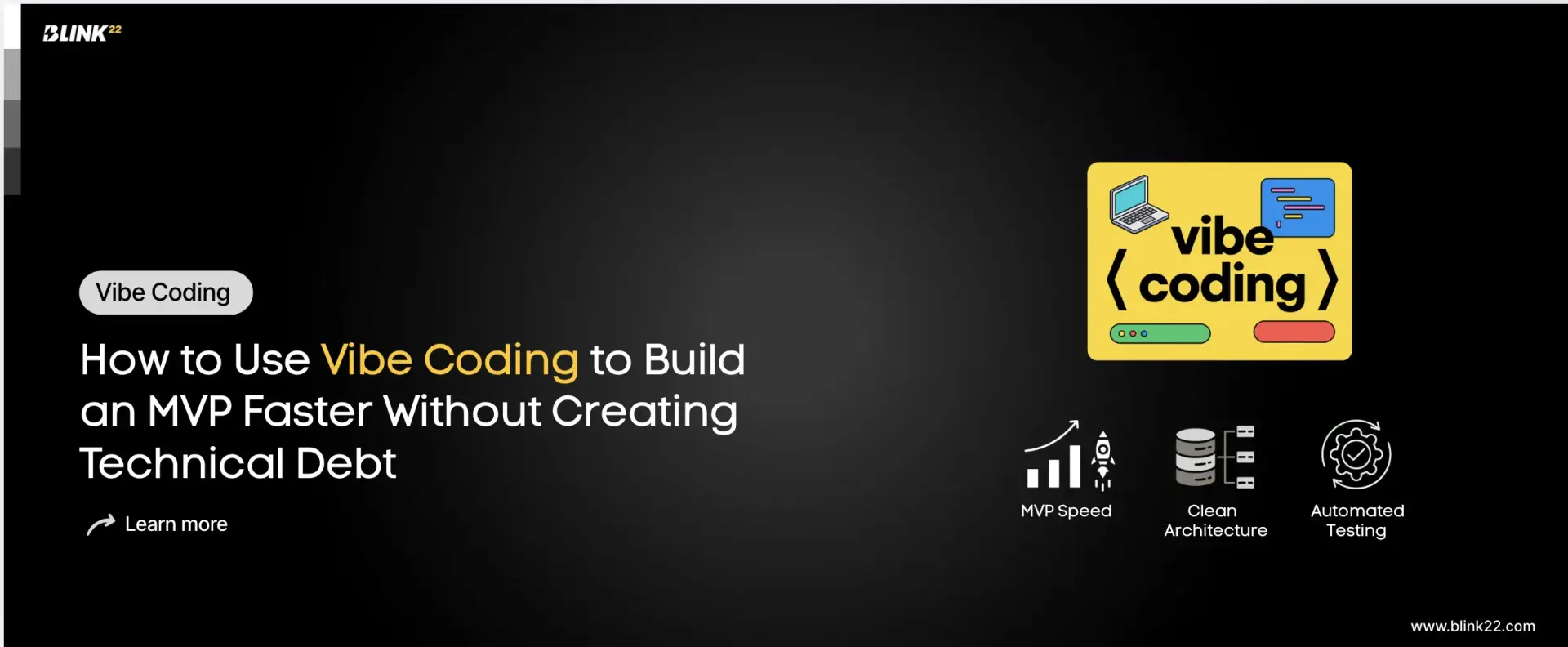
How to Use Vibe Coding to Build an MVP Faster Without Creating Technical Debt
What vibe coding promises: Ship your MVP in a weekend. No engineers. No meetings. Just you, an AI, and an idea.
The reality: Three weeks later, you're drowning in spaghetti code that nobody, including the AI, can explain.
Vibe coding is genuinely powerful. But there's a gap between using it and using it well. This guide is about closing that gap.
Let's talk about what vibe coding actually is, where it shines, where it breaks down, and how you can use it to build an MVP fast without accumulating enough technical debt to sink your product six months later.
What Is Vibe Coding?
The term was coined by AI researcher Andrej Karpathy earlier in 2025, and it described something many developers were already quietly doing: describing what you want in plain English and letting an AI write the code for you.
Instead of writing every line manually, you guide the AI:
"Build a user authentication flow."
"Create a dashboard showing customer analytics."
"Add Stripe payments and subscription management."
The AI generates code. You don't review every line. You don't always understand what's happening under the hood. You just... vibe.
It's AI-assisted software development stripped of its safety rails.
AI tools, like Claude, Lovable, and Replit, made this accessible to everyone, including those who've never written a line of production code in their lives.
You can prompt your way to a working login flow, a landing page, or a database schema. Sometimes in minutes.
This is why the term "vibe coding" resonates with founders. You're building based on intent and direction rather than getting buried in syntax and boilerplate.
But "working" and "production-ready" are two very different things!
Why Founders Love It (And They're Right To)
The appeal is obvious. AI is fast, and so it allows you to validate your idea at a speed that no human can match. The old model, where you needed to hire a development team, write specs, wait a couple months, then launch, is too slow.
With vibe coding, you can:
Spin up a functional prototype in days, not months
Test assumptions with real users before committing to architecture
Participate more actively in product creation even if you have very little technical background
Iterate without waiting on engineering bandwidth
Reduce early-stage costs dramatically
The build MVP with AI approach genuinely works at the validation stage. You don't need perfect code to learn whether your idea has legs.
This is where vibe coding is completely legitimate and, frankly, where traditional engineering discipline can slow you down unnecessarily.
The Hidden Risks Nobody Talks About
When AI writes your code and you don't understand it, you're not building a product; you're accumulating obligations. Every shortcut has a tax that comes due later.
The Technical Debt Trap
AI models optimize for making things work right now. They don't know your business will need to handle 100,000 users in six months. They don't know your compliance requirements. They don't know that the authentication pattern they just generated conflicts with the one from two prompts ago.
Cursor and Lovable will happily scaffold you a beautiful mess of duplicated logic, hardcoded values, and functions that do five things each. And it runs… It just can't be maintained.
A shortcut today often becomes tomorrow's bottleneck.
What starts as:
"We'll clean this up later."
Frequently turns into:
"Nobody knows how this module works anymore."
Inconsistent Patterns
AI coding assistants have limited context windows. In long sessions, they start to forget what they built earlier. You may end up with
Two different approaches to the same problem living in the same codebase
Different state management approaches
Inconsistent naming conventions
Repeated business logic
Duplicate functionality
You won’t be able to catch these problems because you're moving too fast to look.
Security Gaps You Can't See
Vibe-coded apps frequently have SQL injection vulnerabilities, exposed API keys in frontend code, missing input validation, and broken access control, not because the AI is careless, but because security requires intent. You have to know to ask for it.
A Practical Vibe Coding Workflow That Actually Scales
The answer isn't to stop using AI tools. It's to use them with structure.
Here's the workflow Blink22 recommends for startup teams:
1. Define before you prompt
Before you touch Claude or Lovable, write a one-pager: what the MVP does, what it doesn't do, who the user is, and what "done" looks like. Vague prompts produce vague code. Clarity compounds.
2. Establish a skeleton first
Use AI to generate the architecture outline, not the implementation. Get the folder structure, the data models, and the API contract. Review it like you would a technical spec. Fix problems here before they're baked into 3,000 lines of logic.
3. Prompt in small, reviewable chunks
The biggest vibe coding mistake is generating hundreds of lines at once and just hoping it works. Generate one component, one endpoint, one function at a time. Read it and understand what it does, even at a high level. Then, approve it before moving on.
4. Use AI to review AI
This is an underrated piece of information, but you can actually paste the code your AI just generated back into the chat and ask it to find security issues, edge cases, and code smells. It's surprisingly effective at catching its own mistakes when prompted specifically to look.
5. Write tests early, even if AI writes them
Prompt your tool to generate unit tests alongside every piece of functionality it builds. You don't need 100% coverage. You need a safety net that tells you when something breaks.
6. Document as you go
At the end of each session, ask the AI to summarize what was built, why decisions were made, and what's still incomplete. Paste it into a Notion doc or a README. This saves future you (and future engineers) enormous pain.
How Teams Like Blink22 Use AI
At Blink22, we've worked with enough startups to know that the tool is rarely the problem. The workflow is.
We treat AI the way we'd treat a very fast, very capable junior developer: talented, eager, useful, but not unsupervised. Every output gets reviewed. Every architectural decision gets a human sanity check. We use AI to accelerate the work we'd do anyway, not to skip the thinking.
In practice, that means:
AI-generated code ships through the same review process as human-written code
We establish coding conventions before AI writes anything, so it matches the existing codebase
We run automated testing on AI outputs before they merge
We treat the AI's architectural suggestions as proposals, not decisions
The result: the speed of vibe coding with the stability of real engineering. Prototypes that can actually become products.
If you're building an MVP right now and want to move fast without painting yourself into a corner, that's exactly the balance we help startups strike.
Frequently Asked Questions
How to effectively use vibe coding?
Start with a clear brief before you prompt anything. Work in small chunks, read what the AI generates, and never move on until you understand what was just built. The founders who get the most out of it treat it as a fast collaborator, not an autopilot.
What is technical debt in vibe coding?
It's the hidden cost of AI-generated code that works now but breaks later. Duplicated logic, hardcoded values, zero tests, no documentation. It runs fine in a demo and falls apart in production. The AI optimizes for your prompt, not your future codebase.
Is vibe coding successful?
Yes, at the right stage. It's genuinely powerful for validation, prototyping, and getting in front of users fast. Where it fails is when founders mistake a working prototype for a production-ready product and skip the engineering discipline needed to scale it.
Building an MVP and not sure when to bring in engineering support? Talk to Blink22. We help startups move fast without the technical debt hangover.