Overview
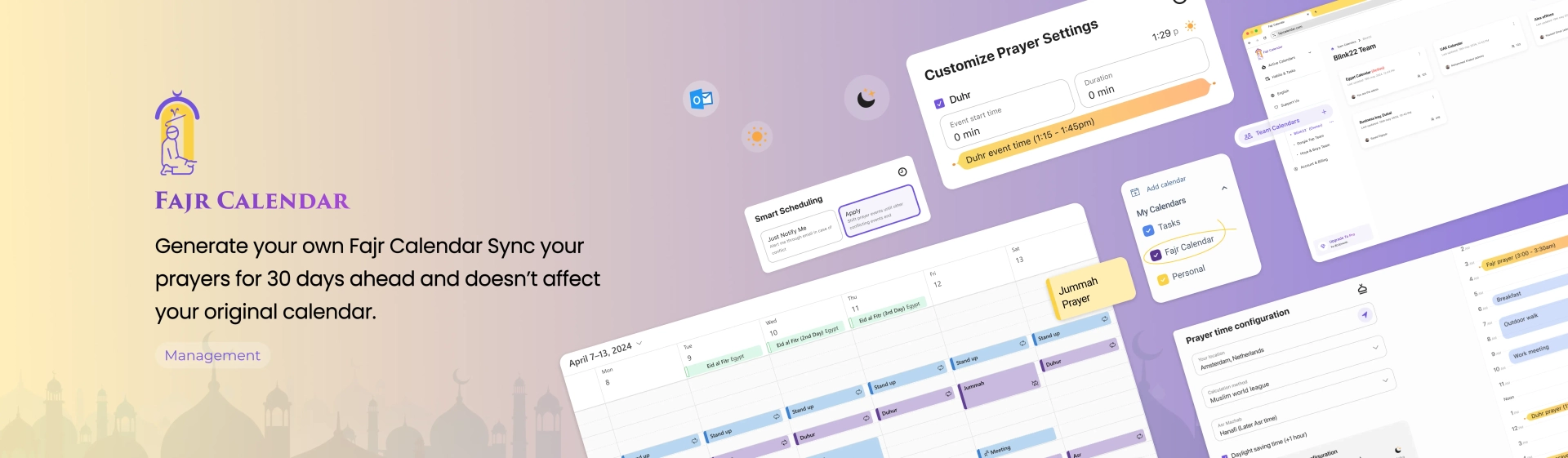
Fajr Calendar was built to bring harmony between spiritual commitment and modern productivity. Designed for the modern Muslim professional, the app merges prayer times, personal events, and work meetings into one cohesive digital experience.
By automatically syncing customizable prayer times to users' Google or Outlook calendars, and embedding a booking tool that respects these protected times, Fajr Calendar turns scheduling into a faith-conscious experience. It's not just another scheduling app, it's a bridge between daily goals and spiritual priorities. Since launch, it has grown well beyond prayer sync alone, into a fuller productivity suite with task management, habit tracking, and team-facing Slack tools.
Technologies Used
 Technologies Used
- NestJS
- PostgreSQL
- AdminJS
App Links
Category
- SaaS & Productivity Platform
- Calendar & Scheduling
- Prayer Time Integration
- Muslim Productivity Tool
- Calendar Synchronization
Platforms
- Web
- iOS
- Android
Timeline
October 2024 – Present
Initial Requirements
Fajr Calendar is an in-house product developed by Blink22 with a bold vision: to eliminate the daily friction between work calendars and prayer apps. Our users, busy professionals, students, and entrepreneurs, were juggling multiple tools that didn’t talk to each other, often resulting in double bookings and missed prayers.
To deliver on this vision, we needed to build a unified platform capable of:
Synchronizing prayer times with Google and Outlook in real-time.
Respecting sacred times through automatic scheduling protection.
Scaling globally, adapting to thousands of users and dynamic time zones.
Integrating simplicity with control, allowing deep customization without sacrificing ease of use.
Growing beyond prayer sync into a full productivity suite, without losing the spiritual focus that made it useful in the first place.
The result would be more than a calendar. It would redefine how Muslims plan their days around both work and worship and eventually how teams do the same together.
Challenge
Building Fajr Calendar required solving a series of intricate design, technical, and product challenges, each centered around reconciling two very different worlds: modern digital productivity and traditional spiritual routines.
1. Bridging Disconnected Systems
Prayer apps and digital calendars operate in isolation, each following their own logic and time models. Our challenge was to connect these systems seamlessly — ensuring that dynamically shifting prayer times could be treated as first-class calendar events within Google and Outlook without disrupting users’ existing schedules.
2. Managing Dynamic, Location-Based Time Data
Unlike fixed meetings, prayer times change daily and differ by geography. We had to build a precise, scalable time engine that automatically recalculates prayer times for each user’s location and updates calendar events in real time — without requiring manual intervention.
3. Balancing Deep Customization with Simplicity
Fajr Calendar needed to serve diverse user needs — from professionals with rigid schedules to students with flexible ones. Designing an interface that offered advanced options (offsets, durations, event visibility, and rounding) while remaining effortless to use required careful UX thinking and progressive feature disclosure.
4. Preventing Scheduling Conflicts
The system had to detect and intelligently handle overlaps between prayer times and existing events. This meant developing conflict resolution logic capable of adjusting prayer entries or alerting users — all while preserving event integrity within external calendar APIs.
5. Designing for Scale and Reliability
As a globally oriented tool, Fajr Calendar needed to handle thousands of simultaneous sync operations across multiple time zones, calendar APIs, and user configurations. The backend architecture had to be both fault-tolerant and fast, ensuring that every calendar feed remained consistent, accurate, and up to date.
Approach
Our approach focused on building harmony between technology and spirituality, so the experience felt both powerful and effortless and stayed that way as the platform grew.
Integration-First Architecture
We began by establishing deep two-way integration with Google Calendar and Outlook APIs. This made Fajr Calendar the single source of truth for all scheduling: no duplicate management, no syncing errors, just one unified calendar. As the platform expanded, we built the same integration discipline into the Slack connection, making it Marketplace-ready with proper status synchronization rather than a bolted-on notification feed.
User-Centric Customization
We developed a powerful yet simple customization engine. Users could adjust prayer start times, event durations, colors, and notifications while the backend automatically handled location-based time shifts and synchronization logic, later improved further to correctly account for daylight saving time across regions.
Iterative Product Expansion
Starting with the core feature, prayer-to-calendar sync, we progressively introduced advanced functionality: full calendar views, booking tools, and conflict detection. From there, the roadmap extended naturally into task management, habit tracking, and Slack integration, each shipped only after the previous layer was solid.
Unified UX Design
Design played a key role throughout. Our UX team built a cohesive visual and interaction system where prayer management, booking, scheduling, tasks, and habits all live within the same intuitive interface. We added Kanban drag-and-drop, FullCalendar-powered views, subtle animations, and full Arabic RTL support.
Solution
We delivered a complete web-based productivity platform that unites faith and functionality, organized around four core pillars.
1. Prayer-Time Intelligence
The foundation of the platform: a synchronization engine that automatically adds and manages prayer times in the user's calendar.
Flexible Sync Options: Add prayers to the primary calendar, a secondary calendar, or import manually.
Per-Prayer Customization: Set relative start times, custom durations, and choose whether to appear "Busy" or "Free."
Conflict Management: Automatically shift prayer events or notify users when overlaps occur, now with real-time detection across both Google and Outlook.
Visual Enhancements: Custom colors, time rounding, and adjustable Friday prayer settings.
Reminders: Built-in notifications make sure prayers are never missed.
2. Scheduling & Booking
A meeting scheduler and online booking system that understands prayer times and gives users real control over how meetings get booked.
Availability Automation: Blocks out prayer and existing meeting times automatically.
Personal Booking Links: Users can share availability with others for seamless scheduling.
Meeting Types & Custom Links: Set up distinct meeting types, each with its own booking link.
Automatic Buffers & Minimum Notice: Build breathing room into the schedule and prevent last-minute bookings.
Rescheduling & Cancellation: Adjust or cancel bookings without back-and-forth emails.
Instant Calendar Sync: Booked meetings appear automatically in Google or Outlook.
Full Calendar Hub: Expanded into a full page experience with event creation, event details, join links, and filtering, alongside Day, Week, and Month views.
3. Productivity Suite
Task management and habit tracking built directly into the same interface as prayer and scheduling.
Multiple Task Views: List, Calendar, Week, Kanban, and Eisenhower matrix, so people can plan the way that suits them.
Drag-and-Drop Kanban: A smooth, responsive board for managing tasks visually.
Habit Tracking with Streaks: Build and maintain habits with visible progress to keep momentum going.
4. Slack for Teams
Bringing prayer-aware scheduling into team workflows, not just individual calendars.
Prayer Notifications in Slack: Reminders delivered where teams already communicate.
Automatic Status Updates: Slack status updates automatically during prayer times.
Meeting Scheduling from Slack: Schedule meetings that respect prayer windows without leaving the workspace.
Team Prayer Reminders: Keep whole teams aligned on prayer times together.
Adhkar (Zikr) Notifications: Adhkar reminders now included alongside prayer notifications in Slack.
Outcome
The launch of Fajr Calendar marked a new standard in Muslim productivity tools – one where faith and functionality coexist seamlessly.
Key outcomes include:
5-Star Rating on Product Hunt, reflecting strong user validation.
Overwhelmingly positive feedback from users who finally found a simple, effective way to plan their day around prayer.
10,000+ active users across multiple countries, showing broad global adoption.
Meaningful user impact: “Awesome idea, adding prayer time to my calendar to avoid any conflicts between meetings.” – Sangam Patel
The project deepened our expertise in calendar synchronization, real-time data automation, and human-centered UX design, while reaffirming Blink22’s belief that great software starts with understanding people’s lives, not just their needs.