Overview
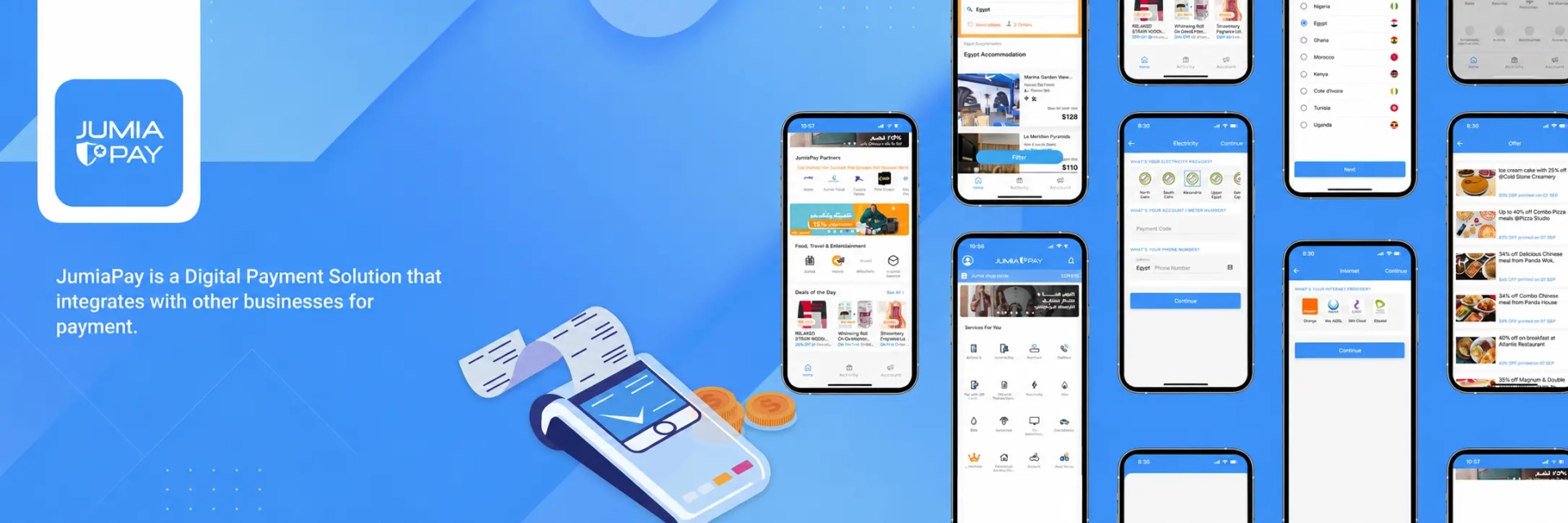
JumiaPay is a leading digital wallet app and ecommerce payment platform operating across Africa, letting users handle utility payments, e-commerce purchases, and money transfers from one app.
Blink22 came on as a trusted fintech app development partner to accelerate JumiaPay's expansion across multiple African markets through integrations built for speed, security, and platform interoperability.
As part of that work, we developed official JumiaPay plugins for major e-commerce platforms, including Shopify, WooCommerce, Magento, and PrestaShop, using platform-specific PHP modules and SDKs.
These integrations let merchants embed JumiaPay directly into their stores, process payments and refunds, and manage order confirmations without leaving the systems they already use.
Technologies Used
 Technologies Used
- Java
- Spring Boot
Category
- Finance (FinTech)
- Payment integration
Platforms
- Android
- iOS
- Web
Initial Requirements
JumiaPay is the digital payment app and fintech engine behind Jumia, one of Africa's largest e-commerce ecosystems. As JumiaPay expanded rapidly across diverse markets, its infrastructure needed to keep pace with its own growth, and that's a harder problem than it sounds.
The goal was straightforward to state and hard to execute: become the most trusted, reliable payment gateway for African consumers. That meant infrastructure built for real scale, local adaptability, and security that couldn't bend under pressure.
Blink22 partnered with JumiaPay as a fintech app development company, embedding engineers directly to build the technical backbone this kind of growth demands.
Challenge
JumiaPay’s rapid regional growth introduced a complex set of challenges:
Multi-Market Expansion
Integrating new, locally trusted payment service providers across high-volume markets like Egypt, Nigeria, Algeria, Ivory Coast, and Kenya, all while keeping transaction reliability high across every one of them.Platform Diversity
Building official plugins for Shopify, WooCommerce, Magento, and PrestaShop. Each platform has its own architecture, which meant separate e-commerce plugin development streams while still guaranteeing the same user experience and security standard across all four.System Consistency and Compliance
Keeping payment state synchronized, running fraud detection, meeting each platform's publishing and review standards, and managing secure transactions without gaps.Operational Coordination
Coordinating across distributed teams (engineering, QA, product, SRE) to run parallel integration and optimization pipelines without touching live operations.
Approach
Blink22 deployed two specialized fintech engineering teams to work across JumiaPay’s integration pipelines and plugin ecosystem.
Full-Cycle Ownership
Each team handled services end-to-end: from requirement analysis and scoping to implementation, testing, and post-deployment monitoring.
Built and maintained tokenized checkout flows with strong security and speed.
Scalable Integration Framework
Developed standardized modules for connecting new payment providers with reduced lead time.
Conducted performance reviews and optimization on legacy integrations.
Ensured compliance with each provider’s standards, fraud detection protocols, and region-specific regulations.
E-Commerce Plugin Expansion
Developed integration plugins for Shopify, WooCommerce, Magento, and PrestaShop using platform-specific PHP modules and SDKs.
Implemented secure payment flows and webhook handling to synchronize transaction states.
Built React-based configuration dashboards that allow merchants to connect their JumiaPay accounts and manage payment settings easily.
Integrated REST APIs and PostgreSQL storage for consistent transaction tracking with JumiaPay’s core database models.
Set up CI/CD pipelines and environment-based builds for rapid deployment across plugin ecosystems.
Reduced new merchant onboarding time from days to minutes.
Solution
Blink22 turned JumiaPay's backend and plugin architecture into something built to keep integrating, not just to work today:
Successfully integrated multiple new payment service providers in Egypt, Nigeria, Algeria, Ivory Coast, and Kenya.
Extended JumiaPay’s reach to hundreds of merchants through official plugins for leading eCommerce platforms, including Shopify, WooCommerce, Magento, and PrestaShop.
Reduced time-to-market for new PSPs from days to minutes and improved plugin availability for e-commerce partners.
Improved transaction reliability through consistent API error handling and webhook monitoring.
Enhanced payment security with tokenization and compliance-friendly flows.
Outcome
JumiaPay now runs on a noticeably more stable and versatile technical backbone, scaling with confidence toward its goal of becoming the leading secure payment solutions provider and digital wallet app for the continent.