Agentic Development vs. Vibe Coding: What's the Difference, and Which Does Your Project Need?
What Is Vibe Coding?
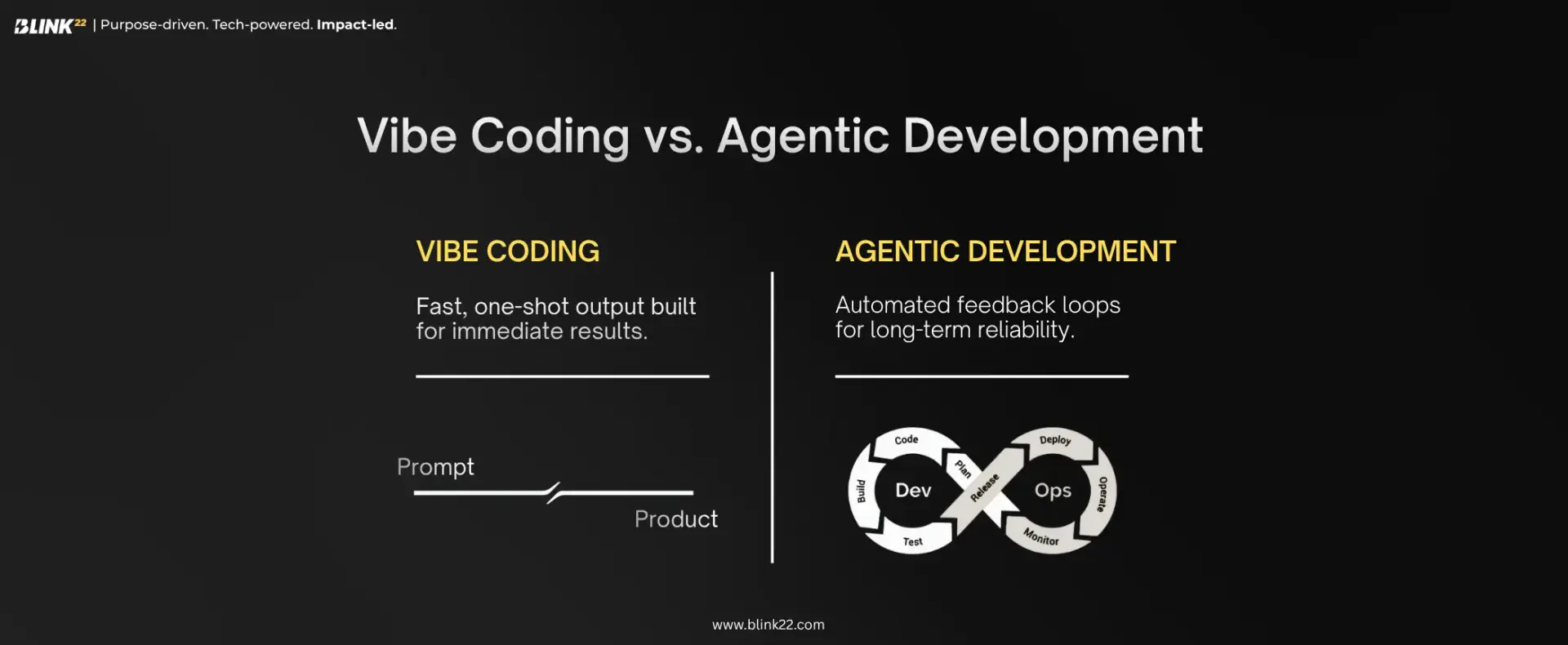
Vibe coding is a term that describes a very specific way of working: the developer stays present, guiding the AI's output through natural language prompts, in a model well-suited to creative ideation, exploratory development, and rapid iteration.
You describe what you want, the AI generates code, you review it, tweak it, and move on. It's a shift in how developers work: from writing every line to orchestrating what an AI produces.
Vibe coding is fast. It's why founders and product teams reach for it to spike a new feature, test three different approaches to a screen, or get a rough prototype in front of users within a day. It's best used to explore when intuition and speed matter more than polish.
It’s also the best approach if you’re not a developer or don’t have a technical background. Anyone with an idea can vibe code their way to a product.
Where it struggles is production. The technique tends to skip design review and testing, which works fine for a demo but collapses under real users, real security requirements, and real scale. An app that looks finished in a weekend demo often isn't built on architecture that can handle a second developer, a security audit, or 10,000 concurrent users.
What Is Agentic Development?
Agentic development (also called agentic coding or agentic engineering) goes further.
Instead of a human prompting for each piece of code, autonomous AI agents independently interpret high-level goals, break tasks into subtasks, plan execution strategies, and adapt based on real-time feedback. You set the goal. The agent plans, writes, tests, and reports back, largely without step-by-step supervision.
The distinction that matters for professional teams is this: agentic engineering keeps engineering judgment in the driver's seat, using AI agents as force multipliers under human direction, while the person building the system retains responsibility for architecture, code quality, and technical decisions. The AI is doing more of the execution, but a developer is still defining the process, guardrails, the spec, and the verification loop it operates inside.
This is why research comparing the two paradigms finds vibe systems thrive in early-stage prototyping and education, while agentic systems excel in enterprise-grade automation, codebase refactoring, and CI/CD integration.
Agentic development is built for scale and repeatability. Vibe coding is built for speed and exploration.
The Real Difference
Vibe Coding | Agentic Development | |
Best for | Prototypes, demos, early ideation | Production systems, refactors, automation |
Human role | Active reviewer of output | Supervisor defining goals and guardrails |
Risk profile | High if shipped without review | Lower, with proper specs and testing built in |
Neither approach is "better" in the abstract. The most effective teams blend both, using vibe coding for speed and agentic systems for scale. The mistake we see most often isn't choosing the wrong one; it's not knowing which stage of a project you're actually in.
Why This Distinction Matters for Founders and Product Teams
If you're building a startup MVP, vibe coding can get a clickable prototype in front of early users or investors fast. But the moment paying users arrive, the calculus changes: you vibe code the prototype, and you agentically engineer the product. Confusing the two is how demos that impressed a room of investors turn into support tickets and security incidents six months later.
This is exactly the handoff point where a development partner earns its value.
Blink22 works with founders at both ends: we'll rapidly prototype a concept using AI-assisted, vibe-coding-style workflows to validate an idea quickly, then rebuild the parts that matter through our structured AI Agent Development process once the product needs to hold up in production.
We've applied this exact approach across client work in fintech, e-commerce, and edtech, where speed to first version and long-term stability both mattered.
Is "Vibe Coding" Just a Buzzword?
It's tempting to dismiss it that way, and plenty of engineers do.
Google engineer Addy Osmani has pointed out that "vibe coding" became a "suitcase term," used to describe everything from a weekend hack to a disciplined agent-driven workflow, with little agreement on what it actually means.
That ambiguity is real. But the underlying practice, natural-language, prompt-driven coding for fast iteration, is genuinely useful when it's applied to the right kind of task.
The problem isn't the technique. It's treating a prototyping tool as a production methodology.
How Blink22 Applies Both Approaches
As a custom software and AI development company working across fintech, e-commerce, edtech, and IoT, we've built our delivery process around exactly this distinction:
Guided MVP Builds: Fast, AI-assisted prototyping paired with expert engineering oversight to deliver a testable, secure product to users and investors within weeks, combining agentic workflows with iterative engineering to move from concept to launch fast.
Agentic Development: Custom software, feature integration, and system builds powered by an agentic approach. Autonomous AI agents collaborate alongside human engineers to handle real workflows, from automated customer support and internal tooling to complex data pipelines, built with strict specs, continuous testing, robust guardrails, and top-tier security.
Scale-Up Engineering Targeted refactoring and production-grade architecture for founders who vibe-coded an early version. Engineers leverage agentic development tools to harden security, optimize performance, and rebuild the foundation without losing momentum or starting from scratch.
If you're not sure which stage your project is in, book a consultation with Blink22 to figure out which service suits you best.
Frequently Asked Questions
Is vibe coding the same as agentic coding?
No. Vibe coding is prompt-by-prompt, with a developer reviewing each output. Agentic coding lets an AI agent plan and execute toward a goal with far less step-by-step human involvement.
Can vibe coding be used for production apps?
Generally not on its own. It's suited to prototypes and early exploration; production apps need the structured planning, testing, and review that agentic or traditional development provides.
Who invented the term "vibe coding"?
AI researcher Andrej Karpathy, in a February 2025 post that quickly became industry shorthand for prompt-driven, intent-first AI coding.
Which approach is right for my startup?
If you're validating an idea, start with rapid AI-assisted prototyping. If you're scaling past early users, or the product touches money, health data, or compliance, agentic development with proper engineering guardrails is the safer path. Our Guided MVP team can help you figure out which stage you're actually in.